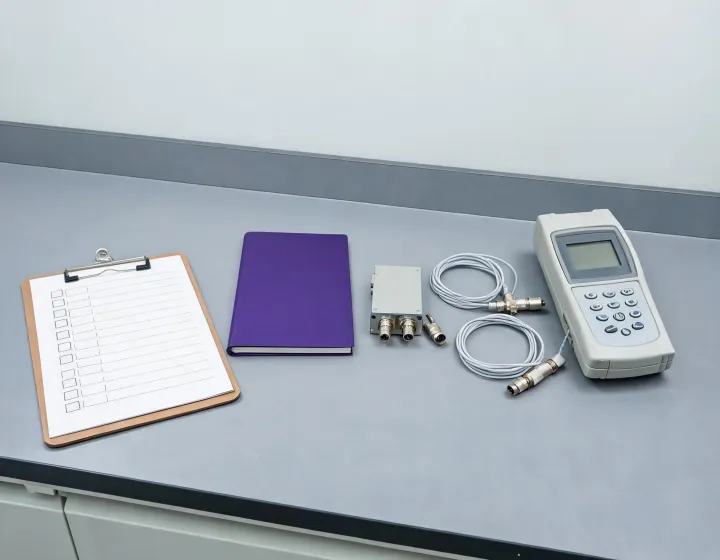
Evidence ledger for the proposed MEMS unit
Ask the factory to fill the right-hand column against the exact model. Leave a cell empty rather than borrowing a number from a 1x2 mechanical sheet.
| Check | Buyer status | Factory evidence to request |
|---|
| Wavelength |
Open until 1310 nm, 1550 nm, or a stated band is chosen |
Insertion loss and return loss at that wavelength, with the method |
| Optical budget |
Spare dB after connectors, still a link calculation |
Switch loss by itself. The factory does not own the transmit power or receiver sensitivity of the host optic |
| Switching behavior |
Latching or non-latching still unmarked |
Switching time, drive voltage, and whether state holds if power drops |
| Repeatability |
Needed when the unit feeds a monitor port |
Repeatability and crosstalk figures from the current sheet, not a brochure range |
| Temperature |
Cabinet ambient unknown |
Rated range for the proposed model. Do not paste -20 C to 70 C from a lab module onto an outdoor hut |
| Compliance file |
Request it when the installation calls for a file |
FCC or NRTL evidence that names this model, when that file is applicable. Absence is an open item |
MEMS and mechanical replies are not the same column
A MEMS fiber switch is often chosen when the buyer wants a compact module, a lower drive power, or a shorter switching time than a bulk opto-mechanical unit. A mechanical unit may be chosen when the buyer wants a clearly latching path and can accept a slower move. Those are tradeoffs to write down. They are not a ranking, and this desk has not measured either family.
If an alternative arrives, verify four items before it is accepted: the wavelength table, the connector and polish, the control pinout, and the loss against the spare optical budget. A shared fiber photo is not one of the four. Crosstalk and repeatability should be re-read when the path is a monitoring tree rather than a protection 1x2.
Dispersion, channel width, and MIMO do not describe this switch. Leave them off the ledger so a network-radio template does not pollute the fiber note. Impedance and VSWR belong on RF lines, not on a MEMS fiber module. ITU-T optical-fibre recommendation material was used as a question source on 2026-10-27. It does not certify insertion loss, return loss, or crosstalk for an unnamed module. A buyer can ask for one sample piece and repeat insertion loss and return loss at the stated wavelength on a calibrated power meter before releasing the balance quantity. That check is the buyer test, not a result published by this desk.
Worked decision, not a shipment record: a lab buyer needs a 1x8 MEMS tree at 1550 nm, LC/UPC, loss target at or under 1.2 dB, quantity 6, destination a North Carolina bench, no outdoor rating. A factory offers a mechanical 1x8 with a 10 ms class switching time and a different drive voltage. The checklist marks wavelength and connector as still to be matched, and it marks drive voltage as a deviation. The buyer can reject the alternative or ask for the MEMS model by name. Nothing on this page closes that choice.